On Judgement, Fragment Time, and Focus
In the last few months, I built an iPhone app that allows me to SSH into my Mac Mini, where I run my coding agents. (The iPhone app itself was built with this workflow! Painful, but that’s a different blogpost.) I built a lot of niceties into it to optimize for fragmented attention. Swipeable cards that each represent an agent, with quick response suggestions. A hold-to-speak interaction for single-handed operation. Little visualizations that indicate agent progress, animating as messages and tool calls come through. All designed to fit into Dad-Life™.
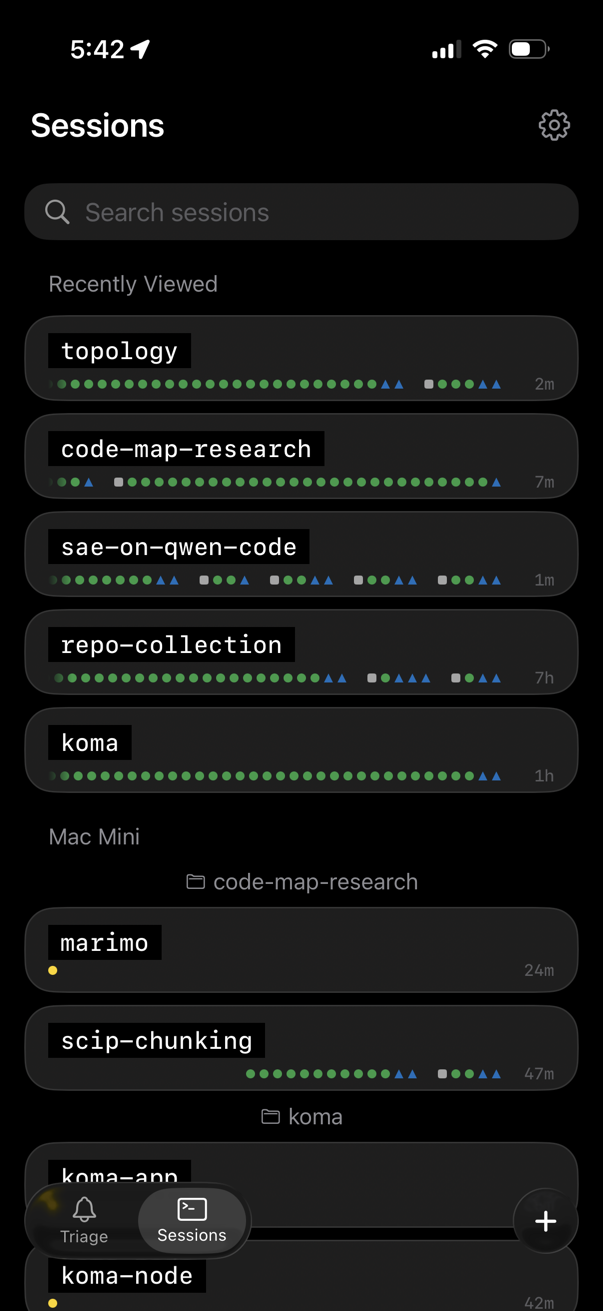
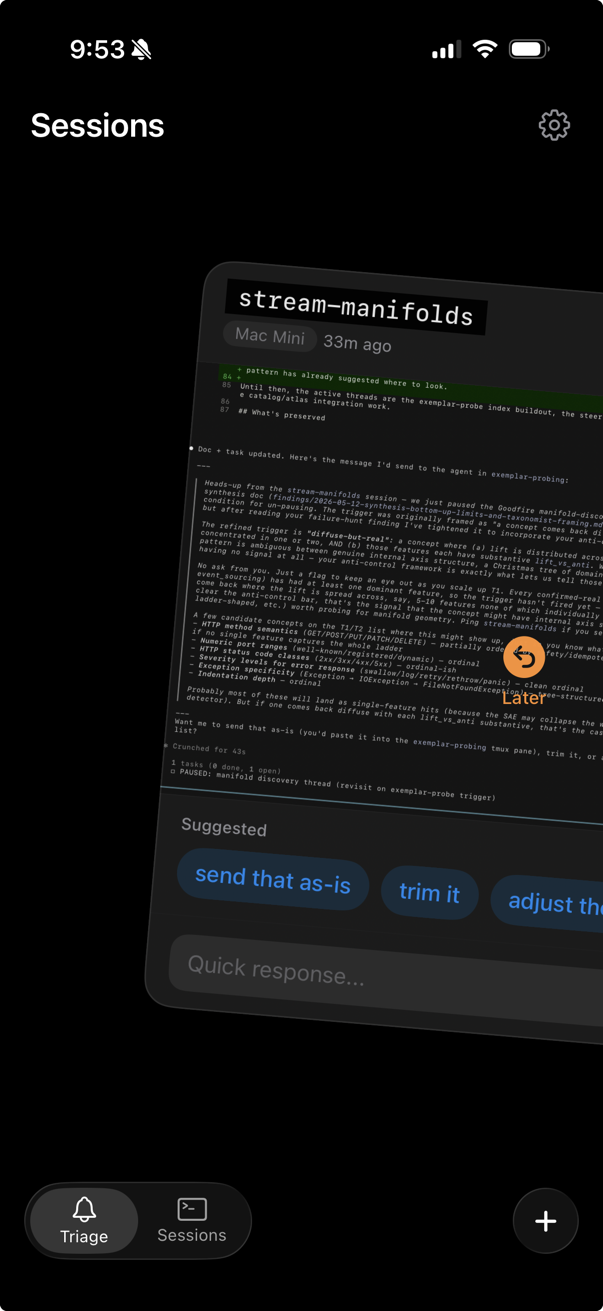
This app, in turn, absorbed 80% of my “fragmented” time usage. Instead of Instagram, or Bluesky, or God-forbid LinkedIn, my agent app is the first thing I check when I pull out my phone in between things. I would dash off a tweet-length prompt, and the agents would dutifully go off and do their thing. And for a while, I felt tremendously productive. And I was tremendously productive, relatively speaking.
But I also noticed a pattern. I would kick off a project, or a thread within one. Initial progress would be incredibly quick and exhilarating. A quick prototype, I say. What about this shape, asks the agent. Go for it. The agent churns for a minute, or five minutes, or thirty minutes, and comes back with … stuff. Often good stuff, but sometimes unexpected results, or a decision that requires deliberation. Meanwhile, I would be in the middle of pushing the wagon with the twins and their basket of strawberries to the grocery store. I don’t have the time to untangle this right now. Swipe to “later”. And that later might be that night, or the next day, or never.
The knots, if they untangle, would often happen only late at night, after pajamas are on, good nights have been said, and the third “last hug” given. Finally I have time to bask in the light of the curved monitor on my desk, with the agent on a third of the screen, the code another third, and the visualizations on the third. Instead of tweet-length prompts, I am hands-on-keyboard, writing multiple paragraphs, deleting them, sitting in the dark for a while, writing it again, pasting in references that I spent twenty minutes reading. Some projects can be detangled quickly. Some need a whole session of discussions before work “flows” again. Without the quiet of the night and the focus it enables, however, threads tend to stay tangled. Ask me how many stalled projects I have. Or actually, do not ask.
Maybe this is not surprising. Agents today makes a whole class of what used to be execution work delegate-able: bootstrap the Astro app, run the numbers, hook up the database with the front-end. Tasks with a clear verification shape run quickly. What remains is work that requires patience, focus, and space. Work that takes work to even articulate — writing a prioritization framework, or intuiting why a design feels wrong. And if it is not amenable to tweet-length prompts, it will pile up until I have time to deliberate, sit, and write.
Which brings me back to Prediction Machines by Agrawal, Gans and Goldfarb. They asserted that as cost of prediction falls (via AI as a mechanism of machine prediction) the value of judgement goes up. The tweet-prompt I dash off between meal prep steps is delegation, and perhaps supervision, of newly low-cost coding agent work.
The work that only happens after the kids are asleep is judgement. Having a quick, always on mobile access to agents only makes it more clear that … the judgement is the work.