T-47: Getting to the Core of Thesis
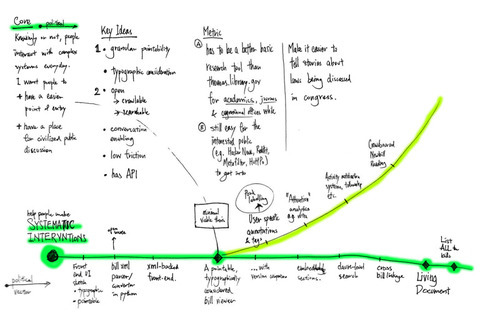
Amit drew us a diagram to illustrate the thesis process. We began at the center, with a core representing what we truly and deeply care about. Out of this core, we can take our thesis in any number of directions. Amit drew a line coming up out of that center point. Given a core and a direction, we can take a thesis as far as we like.
In a sense, Amit is asking us to look for the vector of our thesis.
Along the vector are different points we can reach via a certain vector. The closest one might be a half working prototype. Far out along the line might be a product, or even a business. This week, we are to find our core, contemplate a couple vectors, and get to a first symbolic milestone. The milestone can be discarded later if we decide to change directions, but the idea is to get some momentum.
Core
I spent an hour talking to Amit trying to figure out what the core of my thesis is. I thought I had a breakthrough when I approached him and said, “I think the core of my thesis is to help people with systems thinking.” I managed to summarize all the myriad ideas floating around my head under one framework. I want to help people understand systems in their world, whether it is political systems, or education systems.
“Good. But tell me why you really care. What’s your story?”
Amit was asking why I care, and not just intellectually in the way I am prone to do. Why do I care emotionally and personally? I think the question is, “Why will this idea sustain me when the work gets tough?” I wasn’t prepared to answer that question, but off the cuff, I told Amit this story …
Why Politics?
I remember a night when I was a small child, I was up unusually late with my parents watching television. I didn’t quite understand what was going on, but I knew enough to keep quiet. I saw the ashen look on my parents’ faces. I could hear the tenseness in the news anchor’s voice. I didn’t understand the flickering on TV were flares and gun shots, but I started crying when my parents started crying.
It was the night of June 4th, 1989. My parents, like the rest of Hong Kong, was watching the Tiananmen Square massacre unfold on television.
For Democracy
I teared up even as I told Amit this story. That night, and all it symbolizes, is why I care about politics. Thousands of young Chinese college students put themselves in the way of tank divisions to fight for democracy. They were crushed. There still has been no redress. In China today, there is no acknowledgement of 6/4. Though I grew up in the west, the memory of Tiananmen Square meant that I never took democracy for granted. It grieves me that so few people pay attention to how their countries are governed, and what laws are passed in their name.
So if my thesis, humble as it may be, nudges people to appreciate and participate in their political system just a little more, all the late nights and the up’s and down’s of the thesis process will be worth it.
Postscript: What about Education?
Some of you know that I had entertained the idea of doing a thesis around education for a long time. I still really care, but the vector of that idea seems much less clear than the one about politics. Over the course of the last week, it has become much clearer to me how I might make an interesting intervention in politics using peer networks and interaction design. With the education idea, especially the idea around character and grit education, I am mystified as to how I might put an interaction design spin on it. So, unfortunately I will likely leave it aside.